

Manage your training load and frequency properly and there is a high probability you won’t miss that next workout.
We work with runners, strength-based athletes (powerlifters, Olympic lifters, CrossFitters), and team sport athletes on a daily basis. A common theme we see regarding causative factors for overuse injuries is a quick increase in acute vs chronic workloads. What does that all mean and how does it apply to your sport or injury?
What Are Acute and Chronic Training Workloads?
Defining Acute Workload
Acute workload is the workload performed over a week of training. For runners, this typically means the total kilometers run in a given week.
Defining Chronic Workload
Chronic workload refers to the average training workload over the previous four weeks. To calculate this, you divide the total volume of the past four weeks by four.

Stay Strong, Train Smart
If you want help managing your training loads or reducing injury risk, our team at Defy is here to support you.
Book a session today and get expert guidance tailored to your sport and goals.
Acute vs Chronic Workload Ratio Explained
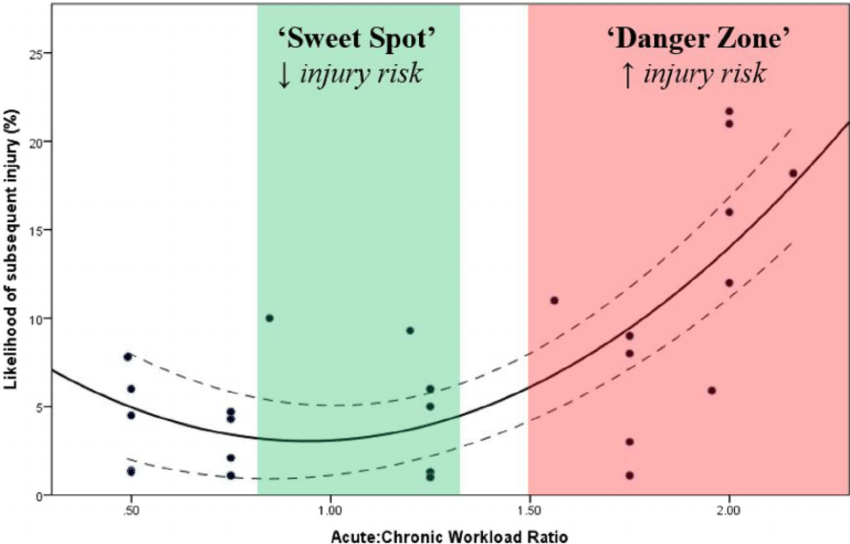
Comparing acute workload to chronic workload as a ratio helps determine an athlete’s preparedness, fatigue state, and injury risk. This ratio allows practitioners and coaches to consider recent training loads relative to what the athlete is accustomed to.
- < 0.80: Undertraining and higher relative injury risk
- 0.80 – 1.30: Optimal workload and lowest relative injury risk (“The Sweet Spot”)
- > 1.50: Highest relative injury risk (“The Danger Zone”)
These numbers provide general guidelines and may vary by sport and individual.
Practical Examples
Example 1: Running Workload
- Week 1: 40km
- Week 2: 50km
- Week 3: 48km
- Week 4: 62km
- Chronic Workload: 50km
- Acute Workload: 62km
- Acute:Chronic Workload Ratio: 1.24 (Within optimal range)
Example 2: Shoulder Pressing Workload
If pressing movements contribute to your shoulder pain, consider your pressing volume:
- Week 1: Overhead Press: 50lbs x10 = 500, 60lbs x8 = 480, 70lbs x6 x3 = 1260
- Week 2: Overhead Press: 1330 + 95lb Thrusters x40 reps = 5130
- Week 3: Overhead Press: 1420
- Week 4: Overhead Press: 1420 + 95lb Thrusters x90 reps = 9970
- Chronic Workload: 4445
- Acute Workload: 9970
- Acute:Chronic Workload Ratio: 2.24 (High injury risk)
Importance of Monitoring Workload
Higher chronic workloads can provide injury resistance if acute loads do not exceed ratios over 1.3. When acute loads spike beyond this, higher chronic workloads become a greater risk factor for injury.
Smart Training Over Complete Rest
Patients are often advised to stop activities completely while recovering, but this may prolong injuries. Maintaining activity close to your chronic workload can help build capacity safely. Athletic therapy and running analysis rehab can further support safe training loads and injury prevention. Train smarter, not harder and be mindful of these factors as you build capacity.
Balancing Load and Capacity
Dr. Andreo Spina of Functional Anatomy Seminars emphasizes:
- Load > Capacity = Injury
- Capacity > Load = Prevention
Building your capacity carefully and monitoring your training loads are essential. For detailed guidance, consider consulting a physiotherapist, chiropractor, athletic therapist or running coach at Defy Sports Performance & Physiotherapy.
References
- Saragiotto BT, et al. (2014). What are the main risk factors for running-related injuries? Sports Med.
- Hulin BT, et al. (2015). The acute:chronic workload ratio predicts injury: high chronic workload may decrease injury risk in elite rugby league players. BJSM.
- Bengtsson H, et al. (2013). Muscle injury rates in professional football increase with fixture congestion. British Journal of Sports Medicine.
- Bourdon P, et al. (2017). Monitoring Athlete Training Loads: Consensus Statement. International Journal of Sports Physiology and Performance.
- Malone S, et al. (2017). The acute: chronic workload ratio in relation to injury risk in professional soccer. Journal of Science and Medicine in Sport.
FAQs
- What is acute workload?
This is the training load over one week. For runners, it is usually the total kilometers run. - What is chronic workload?
This is the 4-week average training load. Divide the total load of the past four weeks by four to find your chronic workload.